PRACTICAL GUIDE · · 5 min read
Four-day homeschool schedule: two realistic weekly examples
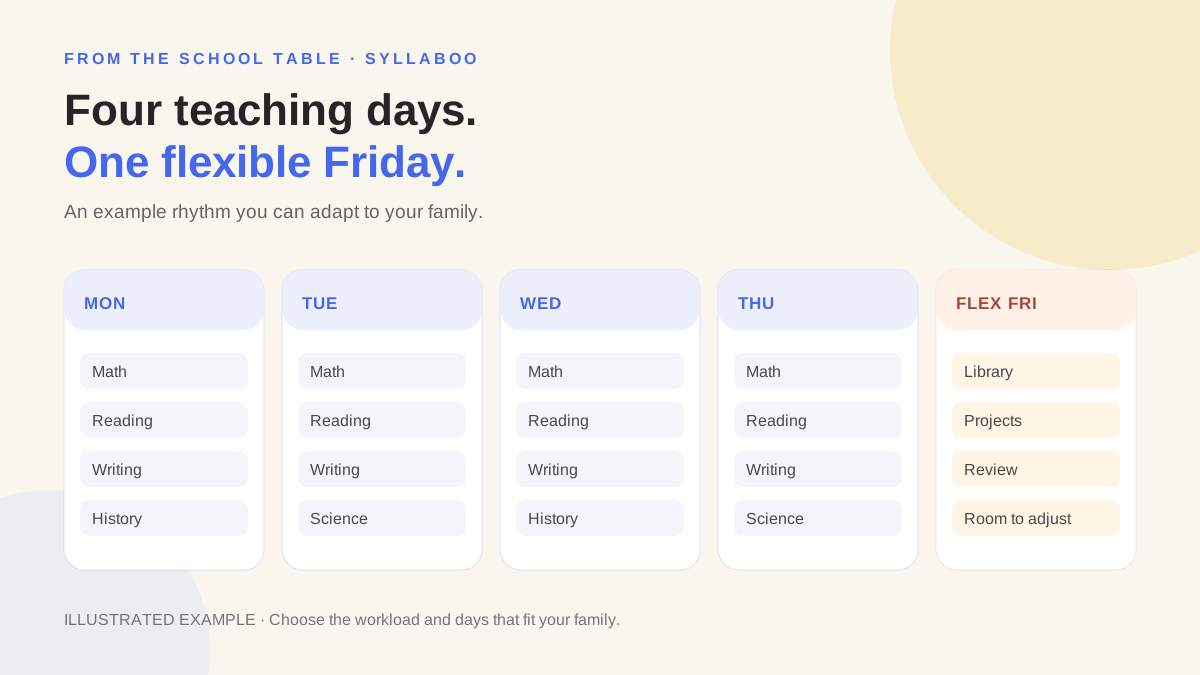
A four-day homeschool schedule can leave room for appointments, lessons that need another try, and mornings when everyone needs a slower start. The goal is a realistic rhythm for your family, with room to adjust.
Start by checking what your curriculum actually asks you to complete. Then choose which work belongs in your four planned teaching days and what the fifth day is for. A schedule that crams five full days into four will usually create the same backlog in a smaller grid.
The two schedules below are illustrative examples, not customer stories or required workloads. Adapt the subjects, lesson lengths, and number of days to your children and the requirements that apply to your family.
STEP 01
Start with the lesson count
List the required lessons in each course. Keep optional projects and enrichment separate so they do not quietly become another full course.
For example, a 120-lesson course taught four times per week takes 30 teaching weeks. If your planning calendar has 36 weeks, the remaining six weeks can absorb review, breaks, or slower progress. You can spread that buffer through the year rather than saving all of it for the end.
That calculation does not tell you how long a lesson takes. Try a few real lessons before you fill the year. A reading, video, and practice page may be components of one lesson rather than three separate school days.
For a fuller pacing example, see how many homeschool lessons to schedule each week.
STEP 02
Example 1: an elementary week
This example assumes one child uses four weekly math lessons, regular reading practice, and rotating content subjects. It leaves the exact clock times open.
Swipe across the table to see every column.
| Learning area | Monday | Tuesday | Wednesday | Thursday | Flexible Friday |
|---|---|---|---|---|---|
| Math | New lesson | New lesson | New lesson | New lesson | Corrections or review if useful |
| Reading | Read together and practice | Reading practice | Read together and discuss | Reading practice | Library visit or chosen book |
| Writing | Short response | Handwriting or spelling | Revise a response | Short finished piece | Finish only what still matters |
| Shared content | History read-aloud | Science lesson | History discussion | Science activity | Field trip, project, or open space |
| Parent check | Prepare materials | Check understanding | Adjust Thursday | Review the week | Choose next week's starting point |
The labels are deliberately specific enough to act on, but not so detailed that the child needs to decode a page of teacher notes. In your own version, replace “new lesson” with the curriculum name and lesson title.
Friday is not a promise to fit every unfinished item somewhere. Decide which work is necessary, which needs more teaching, and which optional activity can be dropped. If Friday becomes a full catch-up day every week, reduce the planned load or revisit the four-day arrangement.
STEP 03
Example 2: two children at different levels
For a mixed-age family, the first constraint is often the parent's teaching time. Two lessons that need the same adult cannot happen together just because they fit into separate child columns.
This example assumes the older child already has some familiar work they can complete independently. If that is not true for your family, shorten the rotation and include waiting, shared reading, or another supported activity.
Swipe across the table to see every column.
| Part of the day | Younger child | Older child | Parent's focus |
|---|---|---|---|
| Shared opening | Listen and discuss at their level | Listen, discuss, and note a question | Read-aloud or shared introduction |
| First teaching rotation | Phonics or guided reading | Familiar reading or practice | Direct teaching with younger child |
| Second teaching rotation | Familiar activity with appropriate support | New math instruction | Direct teaching with older child |
| Break | Snack and movement | Snack and movement | Reset materials |
| Shared subject | Narrate or draw a response | Write a response, map, or explanation | Teach shared content, then check each response |
| Closing check | Show completed work | Show completed work and questions | Review each child's work separately |
Use this rotation across the four teaching days while changing the shared subject: history on Monday and Wednesday, science on Tuesday and Thursday, for example.
Keep skill subjects at the child's level. Sharing a history chapter does not mean the children need identical writing assignments, and one child's completion should not mark the other's work finished.
The multiple-children planning guide shows how a family view and separate daily lists can work together.
STEP 04
Choose the fifth day's job
Give your flexible day a clear purpose. It might hold a regular co-op commitment, a library trip, project time, or a short review of work that needs attention. It can also remain lightly planned.
Write down the work that actually happens. A planned day, an appointment, and a completed lesson are different records; deciding to use a four-day routine does not settle your family's reporting requirements.
Avoid using “flexible” as another word for unlimited. If the list is too long, choose the next useful step instead of stacking every missed task onto Friday.
STEP 05
Review the first two weeks before planning the whole year
After trying the schedule, ask:
- Which lessons consistently took longer than expected?
- Did two children need direct help at the same time?
- Were instructions clear enough to begin the familiar tasks?
- Was the flexible day genuinely flexible?
- What can be removed, shortened, or moved before next week?
Change one or two things and try again. You need a schedule that reflects how your family learns, not a perfect-looking calendar that takes longer to repair than to use.
STEP 06
Get the blank weekly planner
Download the free five-page homeschool planner pack. It includes a weekly grid, daily plan, quarter overview, attendance log, and reading log. No account is required for the blank PDF.
For more sample routines by age, use the existing K–12 schedule-template guide.
If you prefer an editable plan connected to your family's schoolwork, explore the Syllaboo lesson planner. Check current plan features before choosing: saved-plan printing is available on Family and Complete, including the 14-day Complete trial.